Miami Real Estate News for June 3, 2026: Development Is Still Moving, But Buyers Have More Leverage
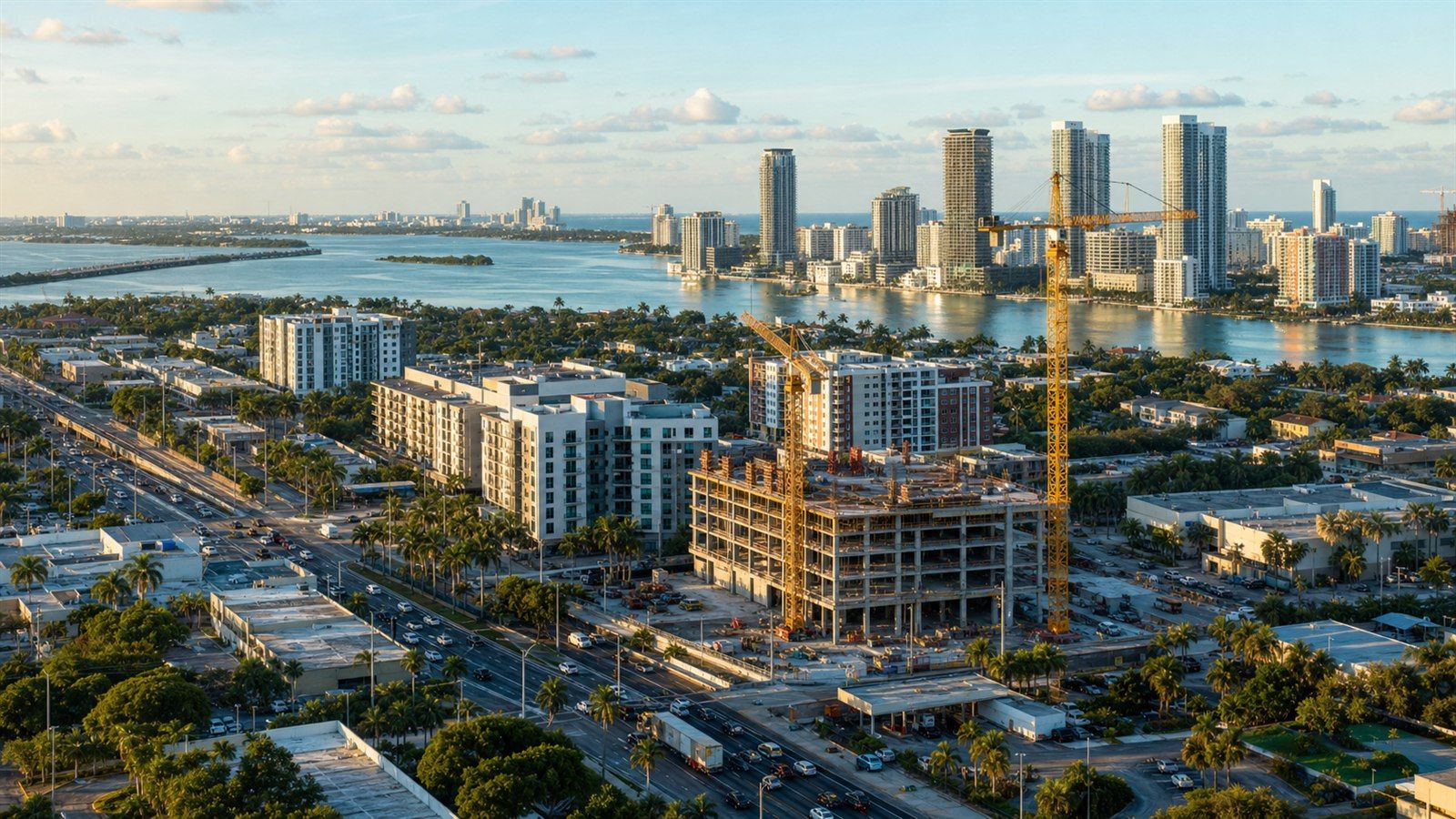
Miami real estate on June 3, 2026 is flashing a very Miami kind of mixed signal: major projects are still moving, global capital is still paying attention, but buyers are getting more selective and older condo owners are feeling more pressure.
That is the useful read today. Miami is not one market. A North Dade industrial and mixed-use filing says land is still being repositioned for growth. An Edgewater waterfront condo tower using EB-5 capital says international demand is still part of the story. At the same time, new property value estimates and current mortgage rates show why pricing strategy, condo due diligence and commute reality matter more than they did during the easy-money years.
Here is what Miami buyers, sellers, homeowners and investors should know today.
1. The big land-use story: Landmark near Miami Gardens
The most Miami-relevant development item today is the proposed Landmark redevelopment near Miami Gardens. Florida YIMBY reported that Landmark QOZB Construction filed a pre-application with Miami-Dade County for an approximately 162-acre mixed-use redevelopment at 20000 NW 47 Avenue Street, near Miami Gardens.
The proposal is not just another tower story. It is a land-use story. The filing seeks zoning changes that would allow a multi-phase plan with a large industrial component, 190 affordable rental units, about 24,000 square feet of commercial space, community facilities, a linear park system and improvements tied to the existing His House Children's Home campus.
For residents, this is worth watching because it sits at the intersection of three Miami-Dade issues: logistics demand, housing supply and North Dade traffic. Industrial square footage can bring jobs and tax base, but it can also change truck movement, commute patterns and neighborhood feel. Affordable housing and retail can be meaningful positives if the site plan connects well to surrounding communities instead of functioning as an isolated project.
The homeowner takeaway: nearby owners should track public hearings, traffic studies, road improvements and final use mix before assuming this is either automatically good or automatically bad for values. In Miami, the details of access, buffering, phasing and public amenities are often what determine whether a large project becomes a neighborhood asset or a daily friction point.
2. Edgewater still has global-capital pull
Axios Miami's June 3 development roundup also highlighted The Cove Residences, A Waterfront Collection in Edgewater, noting that the 40-story, 134-unit waterfront condominium tower that broke ground in late March announced last week that it was accepting EB-5 investments. The project's own site positions Cove as a bayfront Edgewater condominium near Downtown Miami, Wynwood, the Design District and Miami Beach.
The real estate read is not just "another luxury condo." It is that Miami's waterfront preconstruction market is still able to attract international capital even while buyers are more careful about rates, reserves, insurance and delivery risk.
For buyers, Edgewater remains one of Miami's most important due-diligence neighborhoods. The view can be spectacular, but the lived experience depends on the building's capital stack, construction timing, association structure, parking flow, valet operations, causeway access and daily routes. A waterfront address is powerful, but the strongest purchases are still the ones where the numbers and lifestyle both make sense.
For sellers in nearby buildings, new luxury supply can help reinforce neighborhood prestige. It can also raise the bar for older buildings that need to compete on reserves, maintenance, amenities, insurance and pricing.
3. Miami-Dade property values are still rising, but the pace is cooling
Miami Today and the Miami Herald both covered the June 1 property-value estimates from the Miami-Dade Property Appraiser. The countywide taxable value rose about 5.5% over 2025, but that is a clear slowdown from the much hotter gains Miami-Dade saw in the prior cycle.
This matters because taxable values feed local budgets, millage conversations and eventually the homeowner's sense of how expensive it is to hold property here. A countywide gain can sound strong, but the details are uneven. Miami Today reported that the Downtown Development Authority area slowed to a 2.9% valuation increase. The Miami Herald noted weaker existing-property growth in Aventura and much lower new-construction value there compared with two years ago.
The important Miami real estate point is that not every product type is moving together. Well-located single-family homes, scarce waterfront homes and certain affordability-driven submarkets can still perform well. Older condos are dealing with a tougher mix: insurance, reserves, inspections, financing scrutiny and buyer caution.
For condo owners, this is the moment to know your building's numbers before you list. Buyers are asking sharper questions about reserve studies, special assessments, insurance renewals, milestone inspections and lender eligibility. Sellers who prepare that documentation early will look more serious than sellers who wait until inspection or financing to find out what the buyer's lender is going to ask.
4. Rates are still high enough to shape behavior
Mortgage News Daily's 30-year fixed daily index showed 6.57% on June 2, 2026, slightly lower on the day but still high enough to matter for monthly payment math. The latest Freddie Mac weekly reading on that same page showed 6.53% for May 28.
That rate environment helps explain why Miami feels split. MIAMI REALTORS' April 2026 Miami-Dade report showed total home sales up 5.6% year over year, with single-family sales up 8.6% and condo sales up 2.8%. But inventory tells the more practical story: single-family homes had 5.4 months of supply, a seller's market by the association's framing, while existing condos had 12.9 months of supply, a buyer's market.
That means a Miami buyer's leverage depends heavily on what they are buying. A renovated single-family home in a supply-constrained neighborhood is not the same negotiation as an older condo with a long days-on-market count and open questions about reserves. Cash buyers still matter in Miami, too. MIAMI REALTORS reported that cash represented 38.5% of Miami closed sales in April 2026, with cash accounting for 50.9% of existing condo sales.
For buyers using financing, the strategy is simple: get the payment, insurance, association dues and likely assessment exposure underwritten before falling in love with the view. For sellers, the strategy is just as direct: price to today's buyer pool, not the peak-market memory.
5. Broward is still part of the South Florida comparison
Miami is the center of this daily read, but Broward still matters because buyers compare across county lines. MIAMI REALTORS reported Broward total home sales rose 4.7% year over year in April 2026, with single-family sales up 7.6% and condo sales up 1.8%.
The Broward inventory split looks similar to Miami's, though somewhat tighter: 4.6 months of single-family supply and 11 months of existing condo supply. Broward can still offer relative affordability for some South Florida buyers, but the same condo questions apply there too: reserves, insurance, financing eligibility and building condition are now part of the purchase decision.
6. Construction and commute reality are part of value
FDOT's Miami-Dade lane-closure page is also worth watching this week. Its current expressway notices include overnight closures affecting Biscayne Boulevard between NE 11 Street and NE 13 Street, the northbound I-95 ramp to westbound SR 836, and daytime drainage work on NW 2 Avenue from NW 13 Street to NW 14 Street during the June 1 to June 5 window.
This is not just traffic trivia. In Miami real estate, commute reliability is an amenity. A condo with great views can feel different if the buyer's real morning route is stressful. A home near a major redevelopment can look better or worse depending on how truck movement, road work and access are handled.
Before buying, test the route at the actual hour you will drive it. Before selling, be ready to explain access, parking, alternate routes, school runs and nearby construction honestly. Buyers appreciate local knowledge when it is specific.
Bottom line for June 3
Miami is still growing, but the market is becoming more disciplined. Development capital is active. North Dade land is being repositioned. Edgewater still pulls global attention. But property-value growth is cooling, mortgage rates are still high, and condo buyers have more room to question the numbers.
That is not bad news. It is a more useful market. Good properties still move. Weak pricing gets exposed. Buildings with clean financials stand out. Neighborhoods with better access, services and long-term planning become easier to defend.
If you are buying, selling or just trying to understand what today's Miami real estate news means for your next move, William Gartin Real Estate can help you read the local details behind the headlines and make a decision that fits the actual neighborhood, building and market in front of you.
Sources
- Florida YIMBY: Landmark pre-application near Miami Gardens
- Axios Miami: What's going up in Miami
- Miami Today: Miami-Dade property value increases cooling
- Miami Herald: Miami-Dade property values and new construction
- Mortgage News Daily: 30-year fixed mortgage rate index
- MIAMI REALTORS: Miami-Dade April 2026 market report
- MIAMI REALTORS: Broward April 2026 market report
- FDOT Miami-Dade: Expressway lane closures
- Cove Residences official site
Categories
Recent Posts