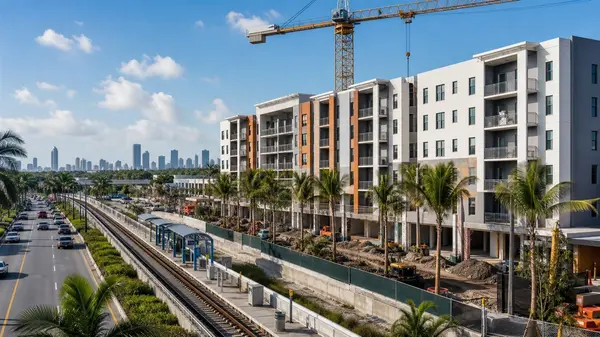
Miami Real Estate 2026: Why Corporate America Is Moving to South Florida and What It Means for Buyers, Sellers, and Homeowners

Corporate America Is Moving to Miami — and the Real Estate Market Is Feeling It
Miami is no longer just a vacation destination or a retirement haven. In 2026, it has become one of the most competitive corporate relocation markets in the United States, and the ripple effects are reshaping how homes are bought, sold, and valued across South Florida. A new CBRE report published in April 2026 ranks the Miami-Fort Lauderdale-West Palm Beach metro area second in the nation for corporate headquarters relocation momentum, trailing only Dallas-Fort Worth. At the same time, fresh data from MIAMI REALTORS shows Miami-Dade home sales have risen for eight consecutive months, with total dollar volume up nearly 12% year over year. These two trends are deeply connected, and anyone thinking about real estate in South Florida should understand why.
Which Companies Are Coming to Miami?
In the first two months of 2026 alone, at least four major companies relocated their headquarters to South Florida. Palantir Technologies, the data analytics firm co-founded by Peter Thiel, moved its headquarters to Miami. Trinity Investments, a private real estate investment firm, relocated from Hawaii to Coconut Grove. GFL Environmental, a Canadian waste management giant, moved its executive headquarters from Ontario to Miami Beach. And D-Wave Quantum, a quantum computing company, selected Boca Raton for its new corporate headquarters and U.S. research facility, moving from Palo Alto, California.
These are not small startups looking for cheap office space. These are established, publicly traded, and well-capitalized firms making strategic decisions to plant their corporate flags in South Florida. According to CBRE's 2026 analysis, six companies chose Miami specifically over other U.S. metros like Los Angeles, the San Francisco Bay Area, and Boston. Two international companies selected Miami for its industry-specific talent pools — one a cosmetics company attracted by the region's concentration of medical spas and aesthetic clinics, and another a travel firm drawn to South Florida's deep bench of hospitality and leisure professionals.
Why Miami? The Business Case Is Getting Stronger
The reasons behind this corporate migration are practical, not just aspirational. Florida's tax system ranks fifth overall on the 2026 State Tax Competitiveness Index, according to the Tax Foundation. The state has no personal income tax, no corporate income tax on many pass-through entities, and recently eliminated the sales tax on commercial leases — a move that directly reduces operating costs for every office tenant in the state.
But taxes are only part of the picture. CBRE's research found that the top reason for corporate relocations in 2025 was consolidating operations and optimizing portfolios, followed closely by business climate, real estate costs, and access to a consumer base. Companies are also citing growth opportunities at a 47% higher rate than in 2024, suggesting that Miami is not just a place to save money — it is a place to expand.
The executive lifestyle factor is real, too. According to Bisnow, in nearly every recent South Florida HQ relocation, the company's chairman or chief executive had already purchased a personal residence in the region before the corporate move was announced. When leaders move their families to Miami, their companies follow. Billionaire developers Ken Griffin and Stephen Ross are building millions of square feet of new office space in Brickell and West Palm Beach, betting that the pipeline of relocations will only accelerate.
How Corporate Relocations Are Driving the Housing Market
When a company moves its headquarters to Miami, it does not just lease office space. It brings employees, consultants, support staff, and their families. Those people need homes. This is one reason Miami-Dade County has posted eight consecutive months of rising home sales. According to the April 2026 data released by MIAMI REALTORS on May 15, total home sales increased 5.6% year over year, with single-family transactions up 8.6% and condo sales up 2.8%. Total dollar volume reached $2.3 billion for the month alone, up nearly 12% from a year ago.
The luxury segment tells an even more dramatic story. Sales of Miami properties priced at $5 million and above climbed 25% compared to last year. Single-family homes priced above $1 million saw a 19.8% increase in sales. These are the price points where relocating executives and their families are most active.
Meanwhile, inventory is tightening. Total active listings in Miami-Dade dropped 11.4% year over year in April 2026. Single-family home inventory fell 14.6%, and condo inventory declined for the third consecutive month — the first three-month decline since July 2023. Single-family homes are now in a seller's market with just 5.4 months of supply. When demand rises and supply falls, prices hold firm and competition increases.
The Brickell and Downtown Miami Effect
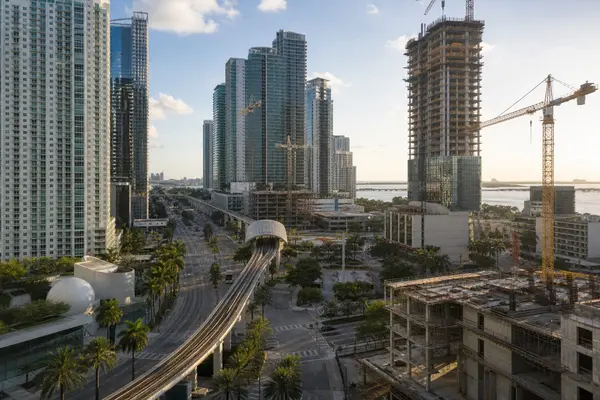
Brickell, Miami's financial district, is ground zero for this transformation. Sometimes called the "Wall Street of the South," Brickell hosts the highest concentration of international banking institutions in the United States outside of Manhattan. The arrival of tech firms, financial services companies, and corporate headquarters is pushing both office rents and residential property values higher in the neighborhood.
Griffin's 54-story Brickell office tower and Ross's One Flagler project in West Palm Beach — where Wells Fargo recently signed a 50,000-square-foot lease for its wealth operations headquarters — represent a new generation of trophy office space designed to attract companies that demand best-in-class amenities and prestige addresses. The residential developments surrounding these office hubs are benefiting directly. Coconut Grove, where Trinity Investments established its new HQ, has seen steady price appreciation. Aventura, Doral, and Coral Gables are all absorbing demand from the growing professional workforce.
Beyond Miami-Dade: Broward and the Wider Region
The corporate migration is not limited to Miami-Dade. Broward County total home sales rose for the second consecutive month in April 2026, according to MIAMI REALTORS data also released May 15. Fort Lauderdale, Hollywood, and Pembroke Pines are all benefiting from professionals who work in Miami but prefer the slightly lower price points and suburban character of Broward neighborhoods. The entire South Florida corridor from Homestead to West Palm Beach is positioned as a single economic region, and corporate relocations strengthen the whole ecosystem.
Southeast Florida already ranks number one in the nation for multifamily construction activity, with 36,290 units under way as of late 2025, according to MIAMI REALTORS Research. This new supply is critical. Without it, the influx of corporate employees would create even more acute affordability pressure across the region.
What This Means for Buyers
If you are considering buying a home in Miami, Miami-Dade, or Broward, the corporate relocation wave adds urgency to your timeline. More professionals arriving means more competition for the same homes. Single-family inventory in Miami-Dade is already at 5.4 months of supply — well into seller's market territory. Properties near employment centers like Brickell, Downtown Miami, Coral Gables, Doral, and Aventura are especially competitive.
For buyers who can act on liquidity, Miami remains a cash-buyer's market. Cash sales represented 38.5% of all closed sales in April 2026, and 50.9% of condo sales were all-cash. If you are financing your purchase, getting pre-approved now and working with an agent who understands local conditions can give you a meaningful edge. Miami remains a bargain compared to other global cities — for $1 million, buyers can purchase 58 square meters of prime property in Miami, nearly four times more than Monaco and nearly double what the same money buys in New York or London, according to the 2026 Knight Frank Wealth Report.
What This Means for Sellers
Sellers in neighborhoods near corporate employment hubs are in a strong position. The combination of declining inventory, rising sales volume, and increasing demand from relocating professionals means well-priced, well-presented homes are attracting serious attention. Single-family homes in Miami-Dade are selling at a median of 95% of their original list price, and luxury properties above $1 million are moving faster than at any point in the past year.
If you are thinking about listing, the current conditions favor sellers who price correctly from day one and invest in professional presentation. Overpricing remains a risk in any market, but the underlying demand from corporate relocations provides a floor of buyer activity that has not existed in previous cycles.
What This Means for Homeowners
Even if you are not buying or selling, the corporate migration wave affects your property value and long-term equity. Miami-Dade homebuyers who purchased a single-family home 15 years ago have a median equity gain of $560,790, nearly double the national average of $300,504, according to MIAMI REALTORS Research. Continued corporate investment in the region supports the economic fundamentals — job creation, population growth, infrastructure spending — that sustain property values over time.
Homeowners in neighborhoods experiencing commercial development or corporate office expansion should monitor local zoning changes and infrastructure improvements. These developments often increase surrounding residential property values. At the same time, the surge in multifamily construction may affect rental income for investment properties, so landlords should stay informed about new supply entering their submarket.
Sources
1. CBRE — "Business Insights: The Shifting Landscape of Headquarters Relocations: 2026 Update" — Published April 6, 2026 — Link — Used for national and Miami-specific corporate HQ relocation data, rankings, industry trends, and relocation reasons.
2. MIAMI REALTORS — "Miami-Dade Home Sales Rise for Eighth Consecutive Month" — Published May 15, 2026 — Link — Used for April 2026 Miami-Dade sales data, inventory, prices, cash sales percentages, luxury market performance, equity data, and Knight Frank comparison.
3. CRE Daily — "South Florida Office Relocations Surge with Corporate HQs" — Published March 12, 2026 — Link — Used for specific company relocation details, billionaire-led migration patterns, and new office construction pipeline.
4. Bisnow South Florida — "Corporate HQs Are Following The Billionaires To South Florida" — Published 2026 — Link — Used for executive relocation patterns, office expansion trends, and tax climate analysis.
5. Tax Foundation — "2026 State Tax Competitiveness Index" — 2026 — Link — Used for Florida's fifth-place ranking in state tax competitiveness.
6. MIAMI REALTORS — "Broward County Total Home Sales Rise for Second Consecutive Month" — Published May 15, 2026 — Link — Used for Broward County market context.
Contact William Gartin
If you are thinking about buying or selling a home in Miami, Miami-Dade, or Broward, contact William Gartin for local guidance, property updates, and real estate advice based on today's market. Whether you are relocating to South Florida for work, investing in the region's growth, or exploring your options as a current homeowner, local expertise matters.
William Gartin with eXp Realty
305-842-6097
williamgartinrealestate.com
Categories
Recent Posts